

Macular Degeneration
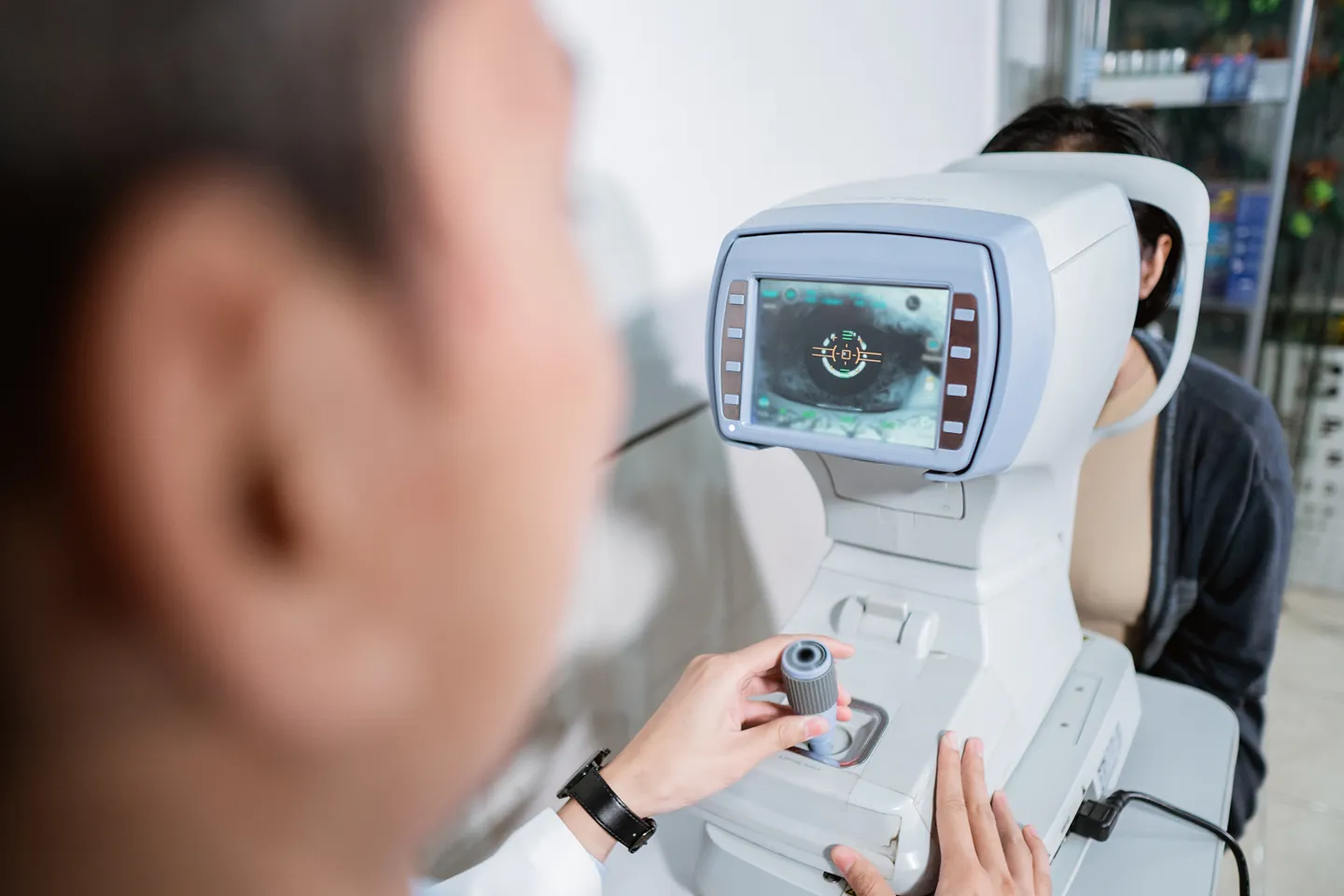
An estimated 11 million people in the United States have some form of macular degeneration, also called age-related macular degeneration (AMD), a leading cause of vision loss in people over 60. This number is expected to double to nearly 22 million by 2050.
The risk of suffering from AMD increases from 2% for ages 50 to 59, to nearly 30% for those over the age of 75.
While there is no cure for macular degeneration, with the advent of injections and lasers, our optometrists can help you manage the condition and may even occasionally restore any loss of sight.
What Is Macular Degeneration?
The macula is the central part of the retina. It’s a vitally important part of our eyes as it is responsible for central vision and much of our color vision, and the ability to see fine details. It allows us to read, recognise faces, drive a car, and so much more.
In fact, the light rays of whatever we are looking at are focused on the macula, be it a photograph of a grandchild, the TV, or your partner’s face.
Macular degeneration is the deterioration of the central part of the retina, the inside back layer of the eye that records the images we see and sends them back to the brain. When the macula is functioning properly, it collects highly detailed images at the center of our vision and sends neural signals through the optic nerve to the brain, which interprets them as sight. When the macula deteriorates, the brain does not receive these clear, bright images and instead receives blurry or distorted images.
Types Of Macular Degeneration
There are two main types of macular degeneration: “dry” and “wet.” Between 85% to 90% of people with macular degeneration have the dry (atrophic) form, but the dry form can eventually lead to the wet (exudative) form.
Another form of macular degeneration is Stargardt disease, which occurs in young people. It is caused by a recessive gene, affecting 1 in 10,000 people.
Wet Vs. Dry Macular Degeneration
- Dry (atrophic) macular degeneration – this is caused when drusen (yellow deposits of proteins) accumulate under the retina, causing retinal distortion. A few small drusen may not change your vision, but as they grow large, they may start to dim or distort vision, especially while reading. As AMD worsens, the light-sensitive cells in your macula further deteriorate and eventually die. With dry AMD, you may also notice blind spots in the center of your vision.
- Wet (exudative) macular degeneration – this is when new and very fragile blood vessels are formed. These abnormal blood vessels leak blood and fluid into the retina, causing vision to become distorted so that straight lines appear wavy. As the blood vessels continue to bleed, they form a scar, potentially leading to partial or full loss of central vision.
By getting regular check-ups, your optometrist can diagnose AMD early on and manage the condition to prevent further vision loss.
Symptoms Of Macular Degeneration
In the early stages of AMD, you might not have any noticeable symptoms. By the time significant symptoms manifest, irreversible damage may have already occurred.
Symptoms of macular degeneration may include:
- Decreased or blurry vision
- Dark or blind spots in the center of your vision
- Lines appearing wavy
- Different color perception
Stages Of Macular Degeneration
There are three stages of age-related macular degeneration.
- Early AMD – Medium-sized drusen deposits and no pigment changes. Most people have no loss of vision at this point
- Intermediate AMD – Large drusen and/or pigment changes. There may be mild vision loss, but most people don’t experience any problems with their daily tasks
- Late AMD – Vision loss has become noticeable
What Eye Exams Can Help Detect AMD?
To check for macular degeneration, your optometrist will perform a comprehensive eye exam that will include:
- Dilated Eye Exam – During this exam, eye drops are used to dilate the pupil. This allows the optometrist to easily see a magnified view of the macula, drusen, or detect abnormal blood vessels.
- Ophthalmoscopy – For this exam, your optometrist will use a hand-held light to detect any damage or changes in the retina and macula.
- Fluorescein Angiography – This uses a dye injected into the bloodstream and is used to detect any leaking blood vessels in the retina.
- Optical Coherence Tomography (OCT) – This test allows eye doctors to see a cross-section through the retina and examine the layers and blood vessels beneath the surface of the retina. This includes the macula, optic nerve, retina, and choroid. Images are seen in 3D and full colour.
- Amsler Grid – An Amsler grid is used by a patient at home, and allows you to self-examine your vision to notice the sudden appearance of any blurry or blank spots in your field of vision. Any changes in vision can be reported immediately to your optometrist. This should not replace your regular yearly eye exam.
Visiting your optometrist regularly and having a comprehensive eye examination can help detect AMD in its early stages, when treatment is most effective. While there is currently no cure for AMD, treatment may slow the disease and keep you from having severe vision loss, and may even be able to restore some loss of sight. Contact our optometrists to find the best treatment plan and to discuss ways to manage your AMD.
Can Macular Degeneration Be Treated?
Macular degeneration is the deterioration of the macula, the central part of the retina responsible for sharp, detailed vision. Age-related macular degeneration (AMD) is the most common form, occurring more frequently with age. There are two types: dry AMD, which accounts for 90% of cases and progresses slowly with drusen deposits under the macula, and wet AMD, which develops from abnormal, leaky blood vessels and can cause sudden and severe vision loss. Early detection is critical to preserving vision and maintaining quality of life.
While there is no cure for dry AMD, nutritional therapy with high-dose vitamins and minerals, such as those in the clinically proven AREDS and AREDS2 formulas, can slow its progression. These supplements include vitamins C and E, lutein, zeaxanthin, zinc, and copper, and are most effective when combined with a healthy diet rich in antioxidants. Wet AMD, on the other hand, can be treated with anti-VEGF injections to reduce fluid leakage and restore some vision, photodynamic therapy using Visudyne and a laser to seal abnormal vessels, or laser photocoagulation in select cases to prevent further damage.
Regular comprehensive eye examinations are essential for early detection and monitoring of AMD. While treatments cannot completely cure the condition, they can slow disease progression, reduce vision loss, and in some cases restore part of the lost sight. Patients in Singapore, including areas such as Tampines and Potong Pasir, can consult optometrists at Eyesight.sg for personalised treatment plans and advice on managing AMD effectively.


Your Vision, Our Priority
At Eyesight.sg, we provide comprehensive eye care, from routine check-ups to advanced solutions. Our services are delivered by trusted optometrists across Singapore. Call us to schedule an appointment for your spectacles, contact lenses, or specialist lens needs. You can also drop by any time to explore our wide range of designer spectacle frames and sunglasses.

Why Choose Eyesight.sg?
- Experienced & Certified Optometrists
- Advanced Diagnostic Technology
- Personalised Care for All Ages
- Multiple Locations Across Singapore

Ready for Better Vision? We’re Here for You at Eyesight.sg.
West Mall Branch
Address: West Mall Shopping Centre, 1 Bukit Batok Central, #04-05, Singapore 658713
Phone: +65 6792 5733
Email: hello@eyesight.sg
Mon–Sun: 11am–9 pm
Tampines Branch
Address: 827 Tampines Street 81, #01-146, Singapore 520827
WhatsApp: +65 9824 1607
Email: hello@eyesight.sg
Mon–Sun: 11am–9 pm
Potong Pasir Branch
Address: 51 Upper Serangoon Rd, #01-07 The Poiz Centre, Singapore 347697
WhatsApp: +65 8809 5996
Email: hello@eyesight.sg
Mon–Sun: 11am–9 pm


© 2026 Eyesight.sg | All Rights Reserved | Privacy Policy | Digital Marketing by Remedo