

Bifocal and Multifocal Contact Lenses
If you are over 40 and have difficulty seeing close up, you probably have a common age-related condition called presbyopia, which is when the eye’s natural lens loses the ability to focus on close objects. Presbyopia is a natural process as the eye ages and affects the majority of people from age 40 and upward. Individuals with presbyopia are often familiar with the need to hold reading materials such as newspapers an arm’s length away from their eyes in order to see clearly, yet reading glasses with bifocal or multifocal (progressive) lenses can help.
Fortunately for those who don’t like the look, feel, or inconvenience of reading glasses, there is another option. Bifocal and multifocal lenses are also available in contact lenses in both soft and Rigid Gas Permeable (RGP) varieties.
Multifocal contact lenses give you added freedom over glasses, and they allow you to be able to view any direction – up, down,wn, and to the sides – with similar vision. People wearing progressive lenses in glasses, on the other hand, have to look over their glasses if they want to view upwards or into the distance.
The Difference Between Bifocal And Multifocal Lenses
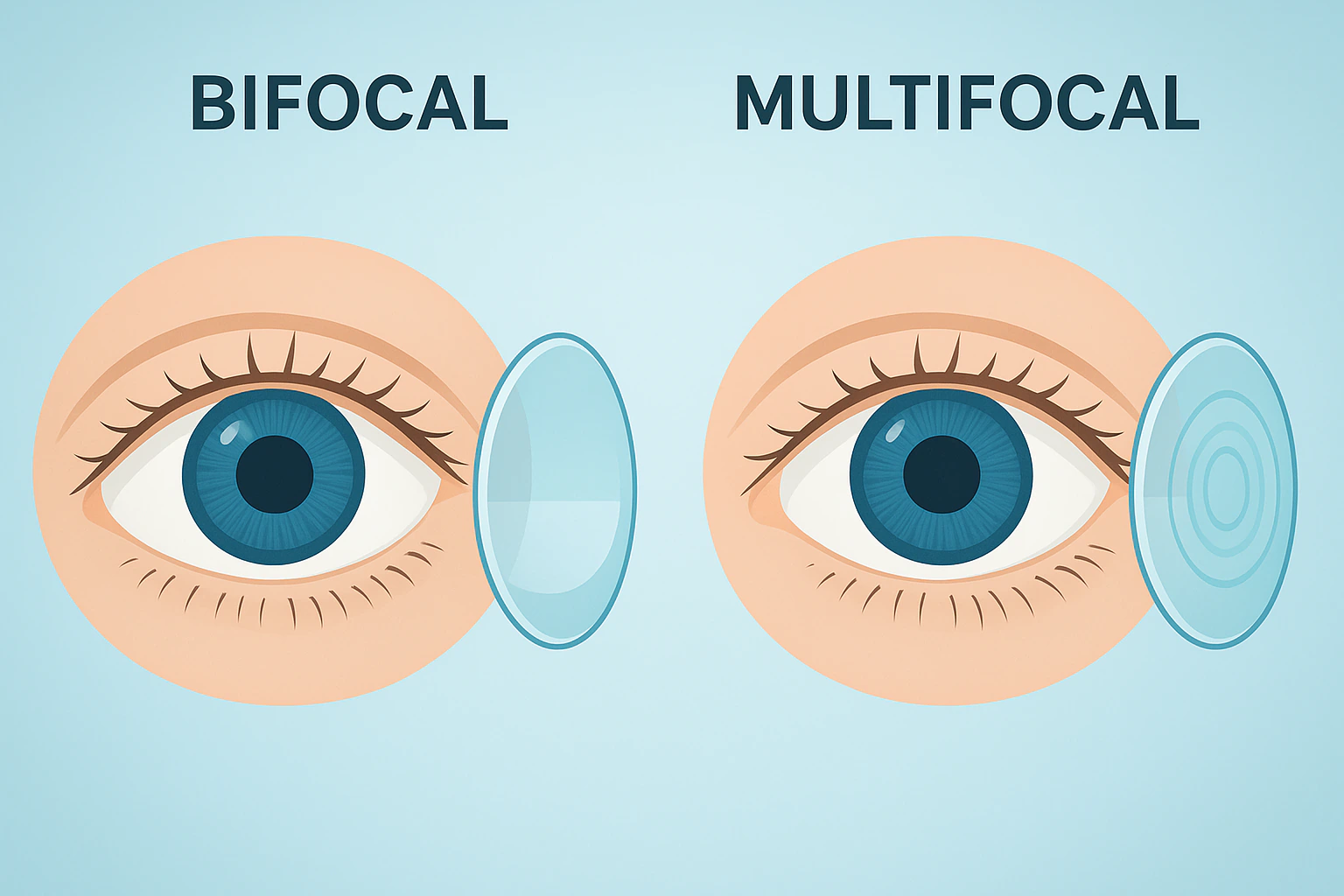
Just as the name indicates, bifocal lenses are divided into two distinct segments for different vision powers, the first for distance vision and the second for near vision. This enables you to clearly switch your focus from near to far as needed, but your vision will not necessarily be clear in between. The term multifocal lenses can refer to any lenses with multiple powers, including bifocals, trifocals, or progressive lenses. Non-bifocal multifocal lenses have a range of powers that enable you to constantly adjust your focus to see clearly from up close to far and in between.
Multifocal contact lenses are generally designed in one of two ways, as either simultaneous vision lenses or alternating vision lenses.
Simultaneous Vision Lenses
The most popular version of multifocal contact lenses, simultaneous vision lenses, presents the distance and near vision zones of the lens at the same time. Typically, after a short adjustment period, your eyes learn to utilise the segment of the lens that they need to focus on the desired object and essentially ignore the other.
They come in two designs:
- Concentric ring design: In the most basic form, these are bifocal lenses that are comprised of a central circular area of one power with a ring around of the alternate power, similar to a bull's-eye. In this design, the power of the rings (either near or distance vision is interchangeable. For intermediate viewing (18-24 inches away), extra rings can be added to create a trifocal or multifocal lens. The width of each ring is variable depending on the power that is needed most, and the edges of the rings can be blended for a smooth transition of focus, similar to progressive eyeglass lenses.
- Aspheric design: These multifocal lenses attempt to provide a natural vision experience by blending many lens powers across the surface and center of the lens. In this design, both distance and near vision power are located in the central visual area, and your eyes will adapt to focus on the area needed to view what you are looking at.
Translating Or Alternating Vision Lenses
Similar to bifocal eyeglass lenses, these contacts are divided into distinct areas or zones, and your pupil will move to the desired zone depending on your vision needs. Typically, the top of the lens, which is what you look through when looking straight ahead, is for distance vision, and the bottom area (what you look through when you look down) is for near vision. However, this can be reversed according to unique vision needs.
Since contact lenses sometimes move within your eye, translating lenses are held in place by a ballast, which is an area that is thicker than the rest of the lens, or by truncating or flattening the bottom to stay in line with the lower lid. These lenses are only available in rigid gas-permeable lens material.
An Alternative Option To Multifocal Contact Lenses: Monovision
Monovision is another contact lens alternative for presbyopia, particularly if you are having difficulty adapting to multifocal lenses. Monovision splits your distance and near vision between your eyes, using your dominant eye for distance vision and your non-dominant eye for near vision.
Typically, you will use single vision lenses in each eye; however, sometimes the dominant eye will use a single vision lens, while a multifocal lens will be used in the other eye for intermediate and near vision. This is called modified monovision. Your optometrist will perform a test to determine which type of lens is best suited for each eye and optimal vision.
Are Contact Lenses Right For You?
If you have presbyopia, contact lenses may be a great option for you. Many people prefer the look and convenience of contact lenses over traditional reading glasses. Speak to your optometrist about the options available to you.


Your Vision, Our Priority
At Eyesight.sg, we provide comprehensive eye care, from routine check-ups to advanced solutions. Our services are delivered by trusted optometrists across Singapore. Call us to schedule an appointment for your spectacles, contact lenses, or specialist lens needs. You can also drop by any time to explore our wide range of designer spectacle frames and sunglasses.

Why Choose Eyesight.sg?
- Experienced & Certified Optometrists
- Advanced Diagnostic Technology
- Personalised Care for All Ages
- Multiple Locations Across Singapore

Ready for Better Vision? We’re Here for You at Eyesight.sg.
West Mall Branch
Address: West Mall Shopping Centre, 1 Bukit Batok Central, #04-05, Singapore 658713
Phone: +65 6792 5733
Email: hello@eyesight.sg
Mon–Sun: 11am–9 pm
Tampines Branch
Address: 827 Tampines Street 81, #01-146, Singapore 520827
WhatsApp: +65 9824 1607
Email: hello@eyesight.sg
Mon–Sun: 11am–9 pm
Potong Pasir Branch
Address: 51 Upper Serangoon Rd, #01-07 The Poiz Centre, Singapore 347697
WhatsApp: +65 8809 5996
Email: hello@eyesight.sg
Mon–Sun: 11am–9 pm


© 2026 Eyesight.sg | All Rights Reserved | Privacy Policy | Digital Marketing by Remedo